
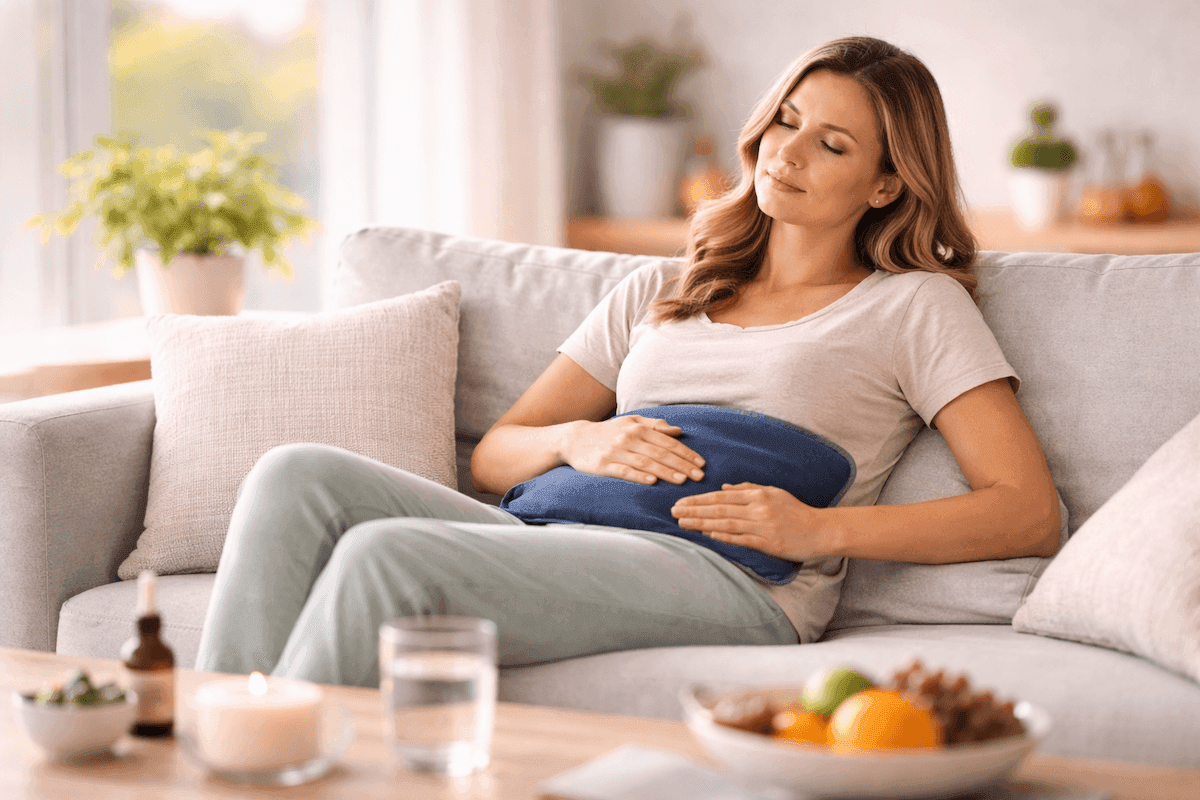
Menstruationsschmerzen gehören zu den häufigsten und am wenigsten beachteten Schmerzformen, die Frauen erleben. Viele der wirksamsten Methoden, sie zu lindern, haben kaum etwas damit zu tun, sofort zu Medikamenten zu greifen. Sie beginnen beim Nervensystem: wie der Körper in und aus dem Stresszustand wechselt, wie Schmerzsignale verstärkt oder gedämpft werden und welche täglichen Übungen beides trainieren.
Dieser Leitfaden behandelt natürliche Schmerzbewältigungstechniken, die bei Menstruationsschmerzen helfen und, im weiteren Sinne, auch bei chronischen Schmerzen und Unterleibsschmerzen, die dieselben Ursachen im Nervensystem haben. Er vereint Beobachtungstechniken, Übungen zur Stärkung des Vagustonus, Nahrungsergänzungsmittel, ätherische Öle und therapeutische Ansätze, ergänzt durch einen kurzen, ehrlichen Hinweis darauf, wann Medikamente dennoch eine Rolle spielen.
Kurze Antwort: Natürliche Techniken zur Schmerzbewältigung bei Regelschmerzen wirken, indem sie ein aus dem Gleichgewicht geratenes Nervensystem beruhigen und die körpereigenen Schmerzlinderungsmechanismen unterstützen. Die Kernpraktiken sind die Verbesserung des Vagustonus durch Atemübungen und Bewegung, gezielte Unterstützung der Ernährung wie Magnesium und Krampfrinde, beruhigende ätherische Öle sowie tiefgreifendere therapeutische Ansätze wie Akupunktur, Beckenboden-Physiotherapie und traumainformierte Therapie, falls nötig.

Der Lebensstil beeinflusst die Fruchtbarkeit. Eine Studie in BMC Public Health zeigte, dass Frauen mit 4–5 gesunden Gewohnheiten ein um 59 % geringeres Risiko für Unfruchtbarkeit hatten.
Fülle den Fragebogen aus und erhalte ein persönliches, ganzheitliches und evidenzbasiertes Programm, das zu dir passt.
 dauert 3 Minuten
Schmerz ist nicht nur ein Signal von einem schmerzenden Muskel oder einer entzündeten Stelle. Er ist ein Dialog zwischen dem Körper und dem Nervensystem, und wenn das Nervensystem in einem „Kampf-oder-Flucht“-Muster feststeckt, wird dieser Dialog lauter. Das Nervensystem zu beruhigen ist eine der wirkungsvollsten natürlichen Schmerzbewältigungstechniken, die dir zur Verfügung stehen.
Zwei einfache Selbsttests können dir einen Eindruck davon vermitteln, in welchem Zustand sich dein Nervensystem gerade befindet.
Der erste ist die Herzfrequenzvariabilität, kurz HRV. Die HRV misst die Zeit zwischen den einzelnen Herzschlägen, und dieser Zeitabstand erweist sich als wichtiger als die Herzfrequenz selbst. Eine niedrige HRV deutet auf ein aus dem Gleichgewicht geratenes Nervensystem hin, das zu „Kampf-oder-Flucht“-Reaktionen neigt. Eine hohe HRV weist auf ein Nervensystem mit guter Erholungsfähigkeit hin, was sich in einer besseren Schmerztoleranz niederschlägt.
Der zweite Test ist eine schnelle Beurteilung der Uvula. Öffne deinen Mund vor einem Spiegel und schau dir das kleine Stück Gewebe an, das hinten in deinem Rachen hängt. Wenn sie schräg statt senkrecht nach unten hängt, kann dies auf eine Blockade des Vagusnervs hindeuten, manchmal aufgrund früherer Verletzungen wie eines Schleudertraumas. Das ist für sich genommen keine Diagnose, aber ein nützlicher Hinweis.
Diese Inhalte dienen ausschließlich Bildungszwecken. Sie wurden auf wissenschaftliche Richtigkeit geprüft, stellen aber keine medizinische Beratung, Diagnose oder Behandlung dar. Wende dich bei medizinischen Fragen oder Entscheidungen zur Kinderwunschbehandlung immer an qualifiziertes Fachpersonal.
Auf wissenschaftliche Richtigkeit geprüft von: Dr. Mona Bungum
Zuletzt geprüft: Mai 2026
Der Lebensstil beeinflusst die Fruchtbarkeit. Eine Studie in BMC Public Health zeigte, dass Frauen mit 4–5 gesunden Gewohnheiten ein um 59 % geringeres Risiko für Unfruchtbarkeit hatten.
Fülle den Fragebogen aus und erhalte ein persönliches, ganzheitliches und evidenzbasiertes Programm, das zu dir passt.
dauert 3 MinutenDer Vagusnerv ist die wichtigste parasympathische „Autobahn“ des Körpers. Je besser sein Tonus ist, desto leichter gelangt der Körper aus dem Stresszustand in einen ruhigen, regenerativen Zustand, in dem die Schmerzen nachlassen. Die meisten der folgenden Techniken wirken direkt oder indirekt, indem sie diesen Tonus verbessern.
Es gibt mehrere praktische, kostengünstige Möglichkeiten, den Vagustonus zu unterstützen. Zwei oder drei davon in den Tagesablauf zu integrieren, ist effektiver, als jede einzelne als einmalige Maßnahme zu betrachten.
Atemarbeit ist der schnellste Weg ins parasympathische Nervensystem, weshalb sie bei Schmerzen so häufig empfohlen wird. Zwei Techniken sind besonders nützlich.
Die Wechselatmung hilft dabei, das parasympathische Nervensystem zu stimulieren und den Körper in einen ruhigeren Grundzustand zu versetzen. Sie eignet sich eher zur täglichen Pflege des Nervensystems als für akute Schmerzsituationen.
Das 4-7-8-Atemmuster basiert auf einem langen Ausatmen, und das Ausatmen ist der wichtigste Teil, um den Körper zu beruhigen. Wenn die Schmerzen stark zunehmen, signalisieren ein paar Runden langsamer, ausgedehnter Ausatmung dem Nervensystem, dass die Bedrohung vorübergeht, was die Intensität der Schmerzsignale verringert.
Wenn du noch keine Erfahrung mit körperlichen Aktivitäten zum Atmen hast, sind sanfte Atemübungen ein guter Einstieg, um dir eine tägliche Gewohnheit anzueignen, bevor du sie in einem Moment starker Schmerzen brauchst.
Sanfte, regulierende Bewegungen unterstützen den Vagustonus auf eine Weise, wie es intensivere körperliche Aktivität nicht tut. Meditation, Yoga und Tai Chi sind allesamt gut belegte Methoden, und das ruhigere Tempo ist ein Grund dafür, warum sie wirken.
Aktivitäten, die den Halsbereich einbeziehen, sind besonders wirksam, da der Vagusnerv durch diesen Bereich verläuft. Singen, Chanten und Summen regen ihn an. Das muss keineswegs wie eine formelle Übung aussehen. Ein paar Minuten Summen am Morgen oder ein Lied unter der Dusche unterstützen dein Nervensystem wirklich.
Für Frauen, deren Schmerzen mit dem Menstruationszyklus zusammenhängen, kann es besonders hilfreich sein, sanfte Bewegung in die zweite Hälfte des Zyklus zu integrieren. Die Vorteile von Kinderwunsch-Yoga gehen über die Fertilität hinaus und wirken sich positiv auf das Wohlbefinden während der Menstruation aus, da der zugrunde liegende Mechanismus derselbe ist: ein ruhigeres, besser reguliertes Nervensystem.
Manchmal hat eine Vagusblockade eine körperliche Komponente, die sich durch Übungen allein nicht beheben lässt. In diesem Zusammenhang wird die kraniale Osteopathie als wirksames Mittel zur Behandlung solcher körperlicher Vagusblockaden hervorgehoben, die nach Verletzungen wie einem Schleudertrauma auftreten können. Wenn du eine körperliche Komponente vermutest, kann eine einzelne Sitzung bei einem qualifizierten Therapeuten ein nützlicher diagnostischer Schritt sein.
Neben der Arbeit am Nervensystem kann eine gezielte Unterstützung der Ernährung einen echten Unterschied machen, besonders während des Menstruationszyklus, wenn die Schmerzen oft ihren Höhepunkt erreichen.
Eine kleine Auswahl an Nahrungsergänzungsmitteln taucht bei der natürlichen Schmerzbehandlung während der Periode immer wieder auf:
Diese sind am nützlichsten, wenn sie schrittweise eingeführt und mit den oben genannten Maßnahmen für den Lebensstil und das Nervensystem kombiniert werden, anstatt als eigenständige Lösung betrachtet zu werden.
Zur Linderung von Schmerzen und Verspannungen werden mehrere ätherische Öle empfohlen: Muskatellersalbei, Pfefferminze, schwarzer Pfeffer und Kamille. Am einfachsten verwendest du sie als verdünnte Rollerball-Mischung: einen Tropfen ätherisches Öl auf einen Esslöffel Trägeröl. Einmal gemischt, hast du eine handliche, gebrauchsfertige Lösung, die du in der Tasche oder am Nachttisch aufbewahren kannst.
Wenn Schmerzen anhalten oder ihre Ursachen über einen einzelnen Zyklus hinausreichen, kann eine tiefgreifendere therapeutische Unterstützung das fehlende Puzzlestück sein. Das Video stellt insbesondere vier Ansätze vor.
Akupunktur wirkt auf das Nervensystem und den Kreislauf ein, und viele Frauen stellen fest, dass sie sowohl Regelschmerzen als auch chronische Unterleibsschmerzen lindert.
Die Beckenboden-Physiotherapie zielt auf die muskulären Verspannungsmuster ab, die still und leise zu anhaltenden Schmerzen beitragen, insbesondere bei Frauen, die sich jahrelang gegen Beschwerden gewehrt haben.
Die viszerale Manipulation, die von einem ausgebildeten Therapeuten durchgeführt wird, wirkt auf das Bindegewebe rund um die Bauchorgane ein, das eine Schmerzquelle sein kann, die bei einer standardmäßigen medizinischen Untersuchung selten erkannt wird.
Die traumainformierte Therapie wird aus einem wichtigen Grund einbezogen: Wir speichern unser Trauma im Beckenbereich. Für manche Frauen hängt eine dauerhafte Linderung davon ab, dass neben den körperlichen auch die emotionalen und historischen Ebenen des Schmerzes angesprochen werden. Dies ist der Teil der Schmerzbewältigung, der am häufigsten übersprungen wird, und zugleich der Teil, der, wenn er angegangen wird, oft die größten Fortschritte ermöglicht.
Als ergänzende Übung, die du in schwierigen Momenten zu Hause machen kannst, kann eine geführte Visualisierung zur Schmerzbewältigung dem Nervensystem einen Anhaltspunkt geben.
Natürliche Schmerzbewältigung bedeutet nicht, Medikamente abzulehnen. NSAIDs haben eine berechtigte Rolle, wenn andere Methoden sich als unzureichend erweisen, und sie wirken am besten, wenn sie zum richtigen Zeitpunkt und nicht erst reaktiv eingesetzt werden.
Speziell bei Regelschmerzen besteht der optimale Zeitpunkt darin, die Behandlung bereits in der Woche vor deiner Periode zu beginnen, um entzündungsfördernde Prostaglandine proaktiv anzugehen, anstatt den Schmerzen erst hinterherzulaufen, wenn sie sich bereits festgesetzt haben. So eingesetzt können NSAIDs die natürlichen Techniken gut ergänzen, anstatt sie zu ersetzen.
Stress, Regelschmerzen und chronische Schmerzen sprechen alle am besten auf Beständigkeit statt auf Intensität an. Ein Nervensystem, das die meiste Zeit über ausgeglichen ist, kommt besser mit den Momenten zurecht, die es nicht vermeiden kann. Die Kombination von täglichen Atemübungen mit Stressbewältigung und einfachen Selbsthilfemaßnahmen bei Regelschmerzen ist es, was diese Techniken von der Theorie in echte Linderung verwandelt.
Um die biologischen Hintergründe dafür zu verstehen, warum die Periode überhaupt wehtut, ist das Verständnis von Regelschmerzen eine nützliche Ergänzung zu diesem technikorientierten Leitfaden.
Vor allem aber: Mach kleine Schritte und sei nachsichtig mit dir selbst. Schmerzen lassen selten linear nach, und die Frauen, die am meisten von diesen Methoden profitieren, sind diejenigen, die sich Raum geben, sie langsam aufzubauen.
Die natürliche Schmerzbewältigung bei der Periode kombiniert vier Bereiche: die Verbesserung des Vagustonus durch Atemübungen und sanfte Bewegung, gezielte Nahrungsergänzungsmittel wie Magnesium und Krampfrinde, beruhigende ätherische Ölmischungen sowie tiefgreifendere therapeutische Unterstützung, wenn die Schmerzen anhalten. Wenn du diese Techniken über einen längeren Zeitraum hinweg kombinierst, wirken sie besser als jede einzelne für sich allein.
Der Vagustonus beschreibt, wie gut der Vagusnerv, der wichtigste parasympathische Nervenweg des Körpers, dir hilft, aus dem Stresszustand in die Ruhe zu gelangen. Ein guter Vagustonus geht mit einer besseren Schmerztoleranz einher, da ein ausgeglichenes Nervensystem Schmerzsignale dämpft, anstatt sie zu verstärken.
Ja. Das 4-7-8-Muster basiert auf einem langen Ausatmen, und das Ausatmen ist der wichtigste Teil, um den Körper zu beruhigen. Wenn die Schmerzen zunehmen, signalisiert ein langsames, langes Ausatmen dem Nervensystem, dass die Bedrohung vorübergeht, was die Intensität der Schmerzsignale verringert.
Magnesium in einer Dosierung von bis zu 800 mg täglich kann während des Menstruationszyklus besonders hilfreich sein, und Krampfrinde ist ein traditionelles pflanzliches Mittel speziell zur Linderung von Regelschmerzen. Bei Entzündungen werden häufig Ingwer, Zink, Quercetin und Bromelain zusammen empfohlen.
Muskatellersalbei, Pfefferminze, schwarzer Pfeffer und Kamille sind die wichtigsten ätherischen Öle, die zur Linderung von Regelschmerzen empfohlen werden. Eine einfache Rollerball-Mischung aus einem Tropfen ätherischem Öl auf einen Esslöffel Trägeröl bietet dir eine praktische, sofort einsatzbereite Lösung für unterwegs.
Ja. Yoga, Tai Chi und Meditation fördern den Vagustonus, was wiederum Schmerzen lindert. Singen, Chanten und Summen wirken, weil der Vagusnerv durch den Rachen verläuft; die direkte Stimulation dieses Bereichs unterstützt also die Regulierung des Nervensystems.
NSAIDs haben ihre Berechtigung, wenn natürliche Methoden allein nicht ausreichen. Am wirksamsten ist es, die Behandlung bereits in der Woche vor deiner Periode zu beginnen, um entzündungsfördernde Prostaglandine proaktiv zu bekämpfen, anstatt zu warten, bis die Schmerzen bereits eingesetzt haben.
HRV, also die Herzfrequenzvariabilität, ist die zeitliche Schwankung zwischen den einzelnen Herzschlägen. Eine höhere HRV deutet auf ein Nervensystem mit besserer Regenerationsfähigkeit hin, was mit einer besseren Schmerztoleranz verbunden ist. Du kannst sie schrittweise durch dieselben Methoden verbessern, die auch den Vagustonus stärken: Atemübungen, sanfte Bewegung, Stimmübungen, Schlaf und Stressreduktion.
Natürliche Techniken zur Schmerzbewältigung wirken am besten, wenn sie kombiniert werden. Ein paar Minuten Atemübungen, die richtigen Nahrungsergänzungsmittel, die regelmäßig eingenommen werden, eine Rollerball-Mischung in Reichweite und gelegentliche tiefgehende therapeutische Sitzungen ergeben zusammen etwas, das weitaus wirkungsvoller ist als jede einzelne Maßnahme. Der rote Faden ist die Regulierung des Nervensystems, und genau das ist es, was diese Techniken bei Regelschmerzen, Beckenschmerzen und den chronischen Schmerzmuster, mit denen Frauen so oft still vor sich hin leben, so wirksam macht.
Wenn Menstruationsschmerzen dein Ausgangspunkt sind, fang mit einer Atemübung und einem Nahrungsergänzungsmittel an und baue darauf auf. Mach kleine Schritte, sei nachsichtig mit dir selbst und lass die Praxis in dem Tempo wachsen, das dein Körper tatsächlich verkraften kann.
00:00:00 Kommen wir also zu den Techniken zur Schmerzbewältigung. Ähm, wir werden darüber sprechen, wie du deinen Vagustonus überwachen und verbessern kannst. Wir machen also dort weiter, wo wir aufgehört haben: bei den Lebensstilfaktoren, der Ernährung, den ätherischen Ölen und dann bei den unterstützenden Behandlungen, die du in Anspruch nehmen kannst, sowie den medikamentösen Optionen. Es gibt also verschiedene Möglichkeiten, wie du deinen Vagusnerv überwachen kannst. Eine der eher neuen Techniken. Eine der eher neuen Techniken.
00:00:31 Das ist eigentlich gar nicht so neu, aber in den letzten Jahren ist die Überwachung deiner Herzfrequenzvariabilität immer beliebter geworden. Wenn du also zum Beispiel eine Garmin-Uhr oder eine Apple Watch hast – oder eine von vielen anderen, ich meine, das Ava-Armband –, dann messen viele dieser Uhren deine Herzfrequenz – und zwar nicht nur sie. Deine Herzfrequenz ist etwas anderes als deine Herzfrequenzvariabilität. Deine Variabilität beschreibt das, was zwischen den einzelnen Herzschlägen passiert. Wie du in dieser kleinen Grafik hier sehen kannst, ist der Herzschlag dieser Ausschlag nach oben.
00:00:59 Und dann ist eigentlich die Zeit zwischen den einzelnen Herzschlägen das, Und dann ist eigentlich die Zeit zwischen den einzelnen Herzschlägen das, was wirklich wichtig ist. Ich habe eine Podcast-Aufnahme mit Dr. Jessica Drummond gemacht, die, ähm, einfach eine großartige Expertin für Endometriose ist. Ähm, und wir reden ausführlich über Herzfrequenzmessung, Herzfrequenzvariabilität und darüber, wie man, ähm, zum Beispiel eine Garmin-Uhr nutzt, um tatsächlich zu verstehen, wie dein Vagusnerv funktioniert, ob du eine Funktionsstörung des Nervensystems hast und wie man Fortschritte überwacht.
00:01:28 des Nervensystems hast und wie man Fortschritte überwacht. Das ist also ganz praktisch, wenn du Veränderungen umsetzt – beim Lebensstil, bei der Ernährung, bei Atemübungen und all diesen Dingen –, bei denen du dann Verbesserungen feststellen kannst. Und wenn dann etwas passiert, das dich aus der Bahn wirft, kann es sein, dass du einen Rückschlag erlebst, und dann geht es dir wieder besser. Sie sind also eine wirklich gute Möglichkeit, deine Gesundheit im Auge zu behalten. Also eine geringe Herzfrequenzvariabilität. Ähm, das siehst du hier in der Grafik.
00:01:55 Hier gibt es kaum große Unterschiede. Das zeigt also, dass du ein dysreguliertes Nervensystem hast. Das zeigt also, dass du ein dysreguliertes Nervensystem hast. So gerätst du ganz leicht in diesen Kampf-oder-Flucht-Zustand. Wenn du dagegen eine sehr hohe Herzfrequenzvariabilität hast, ähm, dann gibt es große Unterschiede dazwischen. Wie du hier sehen kannst, ist es bei einem niedrigen Wert so: eine Sekunde, eine Sekunde, eine Sekunde – zwischen den einzelnen Werten ist es immer gleich. Anders ist es,
00:02:20 wenn die Abstände zwischen den Herzschlägen groß sind, zeigt das, dass du dich tatsächlich sehr schnell erholst. Dein Nervensystem ist also in der Lage, mit einer Situation umzugehen und sich Dein Nervensystem ist also in der Lage, mit einer Situation umzugehen und sich dann wieder zu beruhigen. Es kann also reagieren und anschließend wieder zur Ruhe kommen. Es gibt noch andere Möglichkeiten, wie du deinen Vagusnerv überwachen kannst. Ich habe jede Menge Informationen zum Mastzellaktivierungssyndrom, das irgendwie damit zusammenhängt.
00:02:46 Na ja, das hat mit dem Nervensystem zu tun. Ähm, und einige der Dinge, die du dir ansehen solltest und die dazu führen können, dass Mastzellen, ähm, durchdrehen, sind tatsächlich bestimmte körperliche Hindernisse, die deinen Vagusnerv blockieren. Eine Möglichkeit, das zu überprüfen, ist, Hindernisse, die deinen Vagusnerv blockieren. Eine Möglichkeit, das zu überprüfen, ist, dir dein Gaumenzäpfchen (Uvula) anzusehen. Dein Zäpfchen ist also dieses kleine, baumelnde Ding, ähm, da hinten im Hals. Wenn du also „ah“ sagst, kannst du dieses kleine Ding sehen, das
00:03:18 da hinten im Rachen baumelt. Am besten holst du dir eine Taschenlampe, leuchtest damit in deinen Mund und machst das buchstäblich so. Los, aah, schieb deine Zunge nach vorne und probier’s mal aus. Und du solltest darauf achten, dass deine Uvula buchstäblich baumelt Und du solltest darauf achten, dass deine Uvula buchstäblich baumelt und senkrecht nach unten hängt und vibriert. Wenn sie in irgendeiner Weise schräg nach rechts, nach vorne oder nach hinten absteht, ist das ein Anzeichen dafür, dass dein Vagusnerv tatsächlich beeinträchtigt ist.
00:03:44 Und das kann gut an einem Schleudertrauma liegen, wenn du eine Kopfverletzung hattest. Bei mir war es also ganz ähnlich. Ähm, ich hatte schon mehrere Schleudertraumata – bei Autounfällen, beim Wakeboarden, beim Snowboarden und bei verschiedenen anderen Aktivitäten dieser Art. Und deshalb war bei verschiedenen anderen Aktivitäten dieser Art. Und deshalb war es sehr interessant zu sehen, dass meine Uvula definitiv nach rechts abhing. Ähm, und da bin ich dann auf die Osteopathie gestoßen, genauer gesagt auf die kraniale Osteopathie – nicht erst seitdem. Ich wusste schon
00:04:14 immer, dass Osteopathie für mich wichtig ist, weil meine Nackenwirbel schon immer eingerenkt werden mussten. Ähm, weil sie schon immer verschoben waren Und als sie dann ausgerichtet waren und ich die Behandlung hinter mir hatte, hat meine Uvula tatsächlich ganz normal heruntergehängt. Das ist also echt interessant. Und dann bin ich auch viel, viel ruhiger. Und dann bin ich auch viel, viel ruhiger. Das ist ja echt interessant, dass auch der Vagusnerv beeinträchtigt sein kann. Wie kannst du also deinen Vagustonus verbessern? Nun,
00:04:37 da gibt es viele Möglichkeiten, und du könntest hier sehr ins Detail gehen. Aber hier sind einige der wichtigsten Punkte: Und es gibt verschiedene Ebenen. Es gibt sozusagen höhere Ebenen und dann viel tiefere – je nachdem, wie empfindlich dein Nervensystem ist, wie stark deine Schmerzen sind, je nachdem, wie lange du schon unter diesen Schmerzen leidest und ob du ein Trauma erlebt hast. Ähm, zu den grundlegenden, eher einfachen Dingen, ähm, gehören Atemübungen. Also das 1:1-Atmen
00:05:08 oder das 1:2-Atmen, ähm, abwechselnde Atemübungen. Hier machst du also die Wechselatmung. Ähm, und am Ende werde ich dir ein paar Beispiele mit der Kamera zeigen, weil ich noch nicht ganz raus habe, wie ich mein Gesicht gleichzeitig in die Kamera und in diese Präsentation einbeziehen kann, aber die abwechselnden Atemübungen, ähm, oder das abwechselnde Atmen durch die Nasenlöcher, wenn man tatsächlich ein Nasenloch schließt Atmen durch die Nasenlöcher, wenn man tatsächlich ein Nasenloch schließt dein rechtes Nasenloch verschließt und durch das linke Nasenloch einatmest.
00:05:36 Das regt deinen Parasympathikus an. Das hilft dir also dabei, deinen Vagusnerv zu stärken, sodass du erst durch die linke Seite einatmest und dann durch die rechte ausatmest, anschließend durch die rechte Seite einatmest und dann durch die linke ausatmest. Und diese abwechselnde Atmung führst du durch. Und das ist so beruhigend. Es ist absolut unglaublich, wie fantastisch schon zwei oder drei Minuten dieser Atemübung mit abwechselnder Nasenatmung wirken. Ähm, in den Ressourcen dazu werde ich ein paar Links einfügen. Ähm, ich bin mir sicher, dass ich einige dieser Links schon mit denen geteilt habe, einfügen. Ähm, ich bin mir sicher, dass ich einige dieser Links schon mit denen geteilt habe,
00:06:01 die schon lange genug mit mir zusammenarbeiten. Geh wieder zu ihnen zurück. Denk daran, dass sie extrem hilfreich sind. Wenn das alles ist, was du tun kannst, mach einfach ein paar Atemübungen. Und ich sag den Leuten oft: Weißt du, selbst wenn du bei der Arbeit bist und merkst, dass dich etwas aus der Fassung bringt, geh und setz dich auf die Toilette und atme etwa sieben, acht Mal bewusst. Du atmest also vier Sekunden lang ein, sieben lang aus und hältst dann acht Sekunden lang den Atem an. Okay.
00:06:28 sieben lang aus und hältst dann acht Sekunden lang den Atem an. Okay. Genauso ist es auch, wenn du versuchst, deinen Körper zu beruhigen – es geht um das Ausatmen. Das ist wichtig. Dabei wird so viel Sauerstoff wie möglich aus deinem Körper entfernt, sodass sich Kohlendioxid ansammeln kann und du dann wieder einatmest. Das ist wirklich wichtig. Es ist also wirklich wichtig, länger auszuatmen und kürzer einzuatmen. Meditation ist wirklich gut. Das wirkt einfach total beruhigend. Yoga, Tai Chi, Qigong – jede Art von, ähm, Bewegung mit langsamen Abläufen wirkt einfach
00:06:58 – jede Art von, ähm, Bewegung mit langsamen Abläufen wirkt einfach total beruhigend auf das Nervensystem. Und natürlich, wenn du Yoga machst, das, wie ich es nenne, echtes Yoga ist, statt Yoga als Workout. Also einfach alles. Dein Vagusnerv verläuft nämlich durch den hinteren Teil deines Rachens. Alles, was mit Singen, Chanten, Summen oder Ähnlichem zu tun hat, ist wirklich, wirklich gut, um deinen Vagustonus zu verbessern. Gurgeln. Ähm, und wie ich schon sagte, die kraniale Osteopathie ist fantastisch, um deinen Vagusnerv ins Gleichgewicht zu bringen.
00:07:26 die kraniale Osteopathie ist fantastisch, um deinen Vagusnerv ins Gleichgewicht zu bringen. Ähm, ich habe persönlich sehr gute Erfahrungen gemacht und tatsächlich festgestellt, dass meine Blutzuckerprobleme, mit denen ich in letzter Zeit zu kämpfen hatte, alle damit zusammenhängen, dass mein Vagustonus schlecht war. Das hab ich erst vor Kurzem herausgefunden. Und verschiedene Therapeuten haben mir dasselbe gesagt: Ich neige dazu, im sympathischen Nervensystem zu verharren. Das heißt, ich befinde mich ständig im „Kampf-oder-Flucht“-Modus. Und das hat einfach dazu geführt, dass ich
00:07:57 „Kampf-oder-Flucht“-Modus. Und das hat einfach dazu geführt, dass ich ab und zu zu ihnen gehen muss. Die bringen mich irgendwie wieder in diesen parasympathischen Zustand, ähm, was echt hilfreich ist. Fortgeschrittene Techniken, ähm, wie zum Beispiel Neuro. Vielleicht hast du schon mal von Neural-Beats und Programmen zum Umtrainieren des Nervensystems gehört, wie zum Beispiel dem Gupta-Programm. Und, ähm, also für diejenigen, die besonders unter dem Mastzellaktivierungssyndrom leiden – was ein echtes Anzeichen dafür ist, dass dein Nervensystem völlig aus dem Gleichgewicht geraten ist,
00:08:28 und vielleicht eine Masterclass dazu veranstalten oder das Thema einfach mal kurz in einer und vielleicht eine Masterclass dazu veranstalten oder das Thema einfach mal kurz in einer der Coaching-Sitzungen ansprechen. Bei einer Reihe von Frauen tritt das Mastzellaktivierungssyndrom in Verbindung mit Östrogen und Endometriose auf. Und so wenden wir einige dieser fortgeschritteneren Techniken bei denen an, deren Nervensystem einfach völlig überreizt ist. Neural-Beats und diese Programme zum Umtrainieren des Nervensystems sind oft genau das, was man eigentlich braucht. Geh es viel langsamer an.
00:08:56 Also Lebensstilfaktoren, ähm, um noch mal auf das Thema Ruhe und Entspannung zurückzukommen. Also Lebensstilfaktoren, ähm, um noch mal auf das Thema Ruhe und Entspannung zurückzukommen. Du bist nicht faul, wenn du dich ausruhst. Es ist wirklich, wirklich wichtig, sich die Zeit zu nehmen, um dich zu entspannen und deinen Körper emotional und körperlich zu nähren. Die Belastung durch Schadstoffe reduzieren. Ähm, das ist einfach wirklich wichtig, denn dieser Stress, weißt du, belastet den Körper. Wir sehen das zwar nicht so, aber es ist ein Stressfaktor, weil es dein Entgiftungssystem belastet. Also zurück zu einigen dieser Grundlagen, wie zum Beispiel, keine Plastikbehälter
00:09:25 in die Mikrowelle zu stellen, nicht aus Plastikflaschen zu trinken usw. Ähm, wir haben ja schon darüber gesprochen, dass der Vagustonus dabei eine Rolle spielt. wir haben ja schon darüber gesprochen, dass der Vagustonus dabei eine Rolle spielt. Ähm, und dann noch Visualisierungen. Visualisierungen sind eine wirklich gute Methode zur Schmerzbewältigung, und ich habe sogar eine Audioaufnahme für dich aufgenommen. Ähm, es klingt vielleicht widersprüchlich, aber ich würde es mir anhören, bevor du tatsächlich Schmerzen hast – also noch bevor du merkst, dass du Schmerzen hast –, damit du es dir anhören kannst und es dir tatsächlich sehr hilft.
00:09:55 Ähm, manchmal kann das echt hilfreich sein, wenn du Schmerzen beim Stuhlgang hast. Ähm, du benutzt das, wenn du auf die Toilette gehst, und du wirst merken, dass du Ähm, du benutzt das, wenn du auf die Toilette gehst, und du wirst merken, dass du dich dabei richtig entspannst, und das erleichtert echt den Stuhlgang. Nahrungsergänzungsmittel. Ähm. Ach, davon gibt’s jede Menge. Und weißt du was? Ich werde jetzt nicht auf jeden einzelnen Punkt eingehen. Aber in dem Handout, dem Leitfaden, den ich dir gegeben habe, werden all diese Punkte behandelt.
00:10:22 Ähm, Crampbark ist ein tolles Kraut, das von Kräuterkundigen verwendet wird. Ich finde, es ist fantastisch. Man kann es als Tinktur nehmen, ähm, oder als Tee. Und ich finde, das hilft wirklich gut bei Regelschmerzen, ähm, oder als Tee. Und ich finde, das hilft wirklich gut bei Regelschmerzen, aber nicht, wenn sie extrem stark sind. Es lindert die Schmerzen also ein bisschen. Aber weißt du, wenn du extreme Schmerzen hast, reicht das nicht aus. Und wenn du eine richtig starke Tinktur haben willst, ist es immer eine gute Idee, mit einem qualifizierten Kräuterkundigen zusammenzuarbeiten, denn der kann dir dann
00:10:50 eine Mischung zusammenstellen – also eine Kombination aus verschiedenen Kräutern, die wirklich wirkt. Magnesium gehört auf jeden Fall dazu. Das ist enorm wichtig. Ähm, Frauen mit, Das ist enorm wichtig. Ähm, Frauen mit, ähm, Endometriose haben wirklich einen Magnesiummangel. Einen Mangel. Denn wenn du gestresst bist, verlierst du es regelrecht. Ich verstehe den Mechanismus dahinter wirklich überhaupt nicht. Aber du kannst bis zu 800 mg pro Tag einnehmen. Ähm, also viel mehr,
00:11:17 als man normalerweise denkt. Und das ist besonders gut in der Woche vor deiner Periode und auch während der Periode, oder zu jedem anderen Zeitpunkt, an dem du Schmerzen hast, egal ob es um den Eisprung geht. Bei Zink ist es genauso, und bei Ingwer auch. Die sind alle gut, wirklich, wirklich den Eisprung geht. Bei Zink ist es genauso, und bei Ingwer auch. Die sind alle gut, wirklich, wirklich gut, um sie in der Woche davor einzunehmen. Und das liegt daran, dass es hier darum geht, in der Woche vor deiner Periode deine – na ja – proinflammatorischen Prostaglandine aufzubauen, nicht die entzündungshemmenden – denn das
00:11:45 hilft dabei, die Schmerzen zu lindern und die Entzündung zu reduzieren – und nicht nur zu versuchen, während deiner Periode von all diesen schmerzlindernden Effekten zu profitieren, denn oft ist es dann schon zu spät, weil all diese entzündungsfördernden Prostaglandine bereits in der Woche davor angestiegen sind. Schau dir also bitte das Handout an, ähm, bereits in der Woche davor angestiegen sind. Schau dir also bitte das Handout an, ähm, und lies es durch und probier einfach mal verschiedene Varianten aus. Quercetin und Curcumin – du hast sicher schon mal von Kurkuma gehört. Ähm, aber vielleicht auch weniger bekannte wie Quercetin, das
00:12:14 sehr gut hilft, wenn du Histaminreaktionen hast. Bromelain kommt in Ananas vor, ähm, vor allem im Strunk der Ananas. Vielleicht könntest du es ja mal probieren. Ähm, wenn du Probleme mit dem Blutzucker hast, dann nimm es zusammen mit, na ja, Nüssen und Samen oder so was, damit der Blutzucker sinkt. Nüssen und Samen oder so was, damit der Blutzucker sinkt. Ähm, dann kommen die ätherischen Öle, ähm, die findest du auch im Leitfaden. Ähm, es wird viel über Pfefferminze, Muskatellersalbei und schwarzen Pfeffer
00:12:42 gesprochen – das ist noch einer. Ähm, aber ätherische Öle sind einfach unglaublich. Sie können wirklich, wirklich, wirklich gut sein. Und ich finde sie faszinierend. Und ich finde sie genial – weißt du, vor einer Schwangerschaft und vor allem während der Schwangerschaft. Das ist also etwas, das du, wenn du dich dafür interessierst, wissen Das ist also etwas, das du, wenn du dich dafür interessierst, wissen solltest: Wenn du schwanger wirst, gehören sie zu den Methoden zur Schmerzlinderung, die du sicher anwenden kannst. Es ist ganz gut, sich, ähm, ein paar
00:13:10 der grundlegenden Öle zu besorgen. Aber Muskatellersalbei ist wirklich gut zum Ausgleich des Hormonhaushalts, aber auch zur Linderung von Menstruationsbeschwerden und anderen Symptomen. Und du kannst es mischen – ähm, ich hab’s so gemacht: Du kannst dir – die Links füge ich auch hier ein – ein Trägeröl kaufen, zum Beispiel Mandelöl oder Kokosöl. Und dann gibst du etwa einen Tropfen in einen Esslöffel Trägeröl. Und dann gibst du etwa einen Tropfen in einen Esslöffel Trägeröl. Also ein Tropfen ätherisches Öl auf einen Esslöffel Trägeröl.
00:13:38 Und dann kannst du es einfach in deinen Beckenbereich einreiben, auch den Rücken. Wenn du also Rückenschmerzen hast, ist das auch eine richtig gute Option. Ätherische Öle sind echt toll und es gibt so viele davon. Ich meine, Kamille wirkt ja auch sehr beruhigend. Ähm, und du kannst dir auch eine Mischung zusammenstellen. Ich mache mir oft eine Mischung und kaufe mir diese tollen 10-ml-Rollerballs, ähm, bei Amazon – die gibt’s zum Beispiel im 10er-Pack –, ähm, bei Amazon – die gibt’s zum Beispiel im 10er-Pack –, schreibe ein kleines Etikett drauf und fülle dann den 10-ml-Rollerball mit etwa
00:14:06 6 bis 8 Tropfen. Ähm, das entspricht einer Verdünnung von etwa 3 %. Und dann geht’s ganz schnell. Es ist griffbereit. Es ist fantastisch. Ähm, ich mache die für so viele Leute, weißt du, zum Beispiel für meine Schwester, die unter Regelschmerzen leidet, aber eher ganz normalen, würde ich sagen. Nicht normal, aber keine Endometriose- Regelschmerzen. Aber jetzt schwört sie darauf. Dabei hat sie früher immer, na ja, an so was überhaupt nicht geglaubt. früher immer, na ja, an so was überhaupt nicht geglaubt.
00:14:31 Ähm, aber Jodie Cohen – ich wollte mir das Buch eigentlich besorgen und werde den Link auch noch einfügen. Jodie Cohen hat im letzten Jahr dieses tolle Buch über ätherische Öle und Heilung geschrieben, insbesondere über die Blut-Hirn-Schranke und Schmerzlinderung. Ähm, wie kann man Entzündungen vorbeugen? Und ich habe ein paar Rezepte in diesen Ratgeber aufgenommen, die du ausprobieren kannst, um diese Entzündung zu lindern und die Produktion von, ähm, entzündungsfördernden Zytokinen mithilfe von ätherischen Ölen zu regulieren. Und um noch mal auf die
00:14:59 ätherischen Ölen zu regulieren. Und um noch mal auf die ätherischen Öle zurückzukommen – falls du deine Bu-Pflaster nicht selbst mischen möchtest – ähm, das sind fantastische Pflaster, Schmerzpflaster, die sich hervorragend für Frauen mit Endometriose eignen und die du während deiner Periode einfach auf den Rücken oder den Bauch kleben kannst. Ähm, und sie enthalten eine Reihe von verschiedenen ätherischen Ölen die dann langsam in deine, ähm, in deine Haut einziehen. Und dann das andere. ähm, in deine Haut einziehen. Und dann das andere.
00:15:31 Ich hab hier eigentlich noch gar nicht erwähnt, dass du in der Woche vor deiner Periode Rizinusöl anwenden kannst. Und wenn du dir deinen eigenen Rizinusöl-Rollerball zusammenstellst, ähm, kannst du ätherische Öle hineingeben, den Rollerball auf deinen Bauch auftragen – das kann helfen, die Entzündung zu lindern und wirklich bei Schmerzen helfen. Du kannst das übrigens auch auf den Rücken auftragen. Abends. Und dann mit einem Flanelltuch um den Rücken gewickelt einschlafen. Also unterstützende Therapien. Ähm, wie ich schon erwähnt habe: Akupunktur, Rizinusöl-Umschläge
00:15:58 – ich sag ja oft, wenn du Wärmflaschen benutzt, versuch doch mal, das mit – ich sag ja oft, wenn du Wärmflaschen benutzt, versuch doch mal, das mit kalten Eisbeuteln abzuwechseln. So machst du quasi eine Wechseltherapie mit Kälte und Wärme. Ähm, und dann noch manuelle Therapie. Ähm, also im Grunde genommen Massage oder viszerale Manipulation – da gibt’s viele verschiedene Methoden. Ich hab hier jede Menge Links eingefügt. Aber ich meine, ich werde dir, na ja, ich werde da natürlich einen Link zur Selbstmassage einfügen.
00:16:22 Aber es gibt auch hier viele Möglichkeiten, wie du dir professionelle Hilfe holen kannst. Ähm, Beckenboden-Physiotherapie. Hilfe holen kannst. Ähm, Beckenboden-Physiotherapie. Ich bin hier nicht näher darauf eingegangen. Aber oft, wenn der Beckenboden zu verspannt ist – was bei Endometriose sehr häufig vorkommt –, ähm, ist der Beckenboden zu verspannt. Und das könnte daran liegen, dass du Narbengewebe an verschiedenen Sehnen und Muskeln hast. Es könnte an den Schmerzen liegen, wodurch du
00:16:47 deine Muskeln anspannst. Wenn du dir also deinen Beckenboden ansiehst und Physiotherapie machst – was im Grunde eine innere Massage ist –, ist es wirklich entscheidend, diese verspannten Muskeln zu lockern oder durch Übungen die Stellen zu straffen, an denen die Muskeln schlaff sind. Wenn du, ähm, ein Trauma erlebt hast. zu straffen, an denen die Muskeln schlaff sind. Wenn du, ähm, ein Trauma erlebt hast. Es ist wirklich wichtig, sich mit dem Thema Trauma auseinanderzusetzen und eine Traumatherapie zu machen, denn das ist ein Stressfaktor für deinen Körper, den du tief in deinem Gewebe, insbesondere in deinen Faszien, mit dir trägst.
00:17:16 Ähm, und wir speichern unser Trauma im Beckenbereich. Das ist also wirklich entscheidend. Ähm, schmerzhaft. Es gibt so viele Mittel gegen Schmerzen beim Geschlechtsverkehr. Falls du also davon betroffen bist, werde ich dir jede Menge Links bereitstellen. Ich werde so eine kleine, ähm, Übersicht zusammenstellen, in der du bestimmte Dinge Ich werde so eine kleine, ähm, Übersicht zusammenstellen, in der du bestimmte Dinge nachschlagen kannst, und es gibt Links zu diesen ergänzenden Therapien. Und dann gibt es noch eine Reihe von Maßnahmen gegen Verstopfung, die du ergreifen
00:17:39 kannst. Wie ich schon sagte: Wenn du die Visualisierungsübung machst – du weißt schon, die, bei der du die Knie anziehst und ein paar entspannende Atemzüge machst –, kann das wirklich helfen bei Verstopfung, die bei Endometriose ebenfalls sehr häufig ist. Und dann, zu guter Letzt, die medizinische Unterstützung. Ähm, was die medikamentöse Unterstützung angeht, gibt es immer einen Platz für, ähm, NSAR. Also, entzündungshemmende Medikamente – die helfen wirklich gut gegen Also, entzündungshemmende Medikamente – die helfen wirklich gut gegen
00:18:03 Schmerzen, Fieber und Entzündungen. Aber ich glaube, was man darüber oft nicht versteht, ist, wie man sie richtig einnimmt. Und eigentlich, weißt du, wenn andere Methoden einfach nicht funktionieren und du auf diese zurückgreifen musst – und das ist keine Schande. Wir müssen das tun, denn wenn man tatsächlich Schmerzen hat, muss man diesen Kreislauf durchbrechen und den Körper mit entzündungshemmenden Medikamenten beruhigen, solange man sie braucht. entzündungshemmenden Medikamenten beruhigen, solange man sie braucht. Am besten fängst du schon in der Woche vor deiner Periode an, sie
00:18:33 einzunehmen, denn wie gesagt, das wird diese entzündungsfördernden Prostaglandine reduzieren. Okay. Ähm, also müssen wir sie in der Woche davor und dann während deiner Periode einnehmen, nicht erst, wenn die Schmerzen kommen, und du wirst feststellen, dass sie um einiges wirksamer sind. Ähm, was das angeht, glaube ich, das wisst ihr alle. Nimm sie immer ein, ähm, nachdem du gegessen hast, nicht auf nüchternen Magen, denn sie können deinem, na ja, Magen und deiner nüchternen Magen, denn sie können deinem, na ja, Magen und deiner
00:19:00 Darmschleimhaut ganz schön zusetzen. Also, weiter zu den Tipps. Mach kleine Schritte. Wie ich schon im Coaching-Gespräch erwähnt habe, ähm, mach dir einen Plan und mach dir deswegen einfach keinen Stress. Wenn du also eine PTBS oder ein unbewältigtes Trauma hast, mach dir klar, dass es eine Weile dauern wird, bis sich deine Nerven beruhigen. Und ich glaube, das ist wirklich entscheidend, einfach nett zu dir selbst zu sein. Ähm, und, na ja, lass dich einfach auf den Weg ein. Es ist wirklich, wirklich schwer. Es wird Zeiten geben, in denen du das Gefühl hast, überhaupt nicht voranzukommen, aber das tust du doch.
00:19:27 das Gefühl hast, überhaupt nicht voranzukommen, aber das tust du doch.