
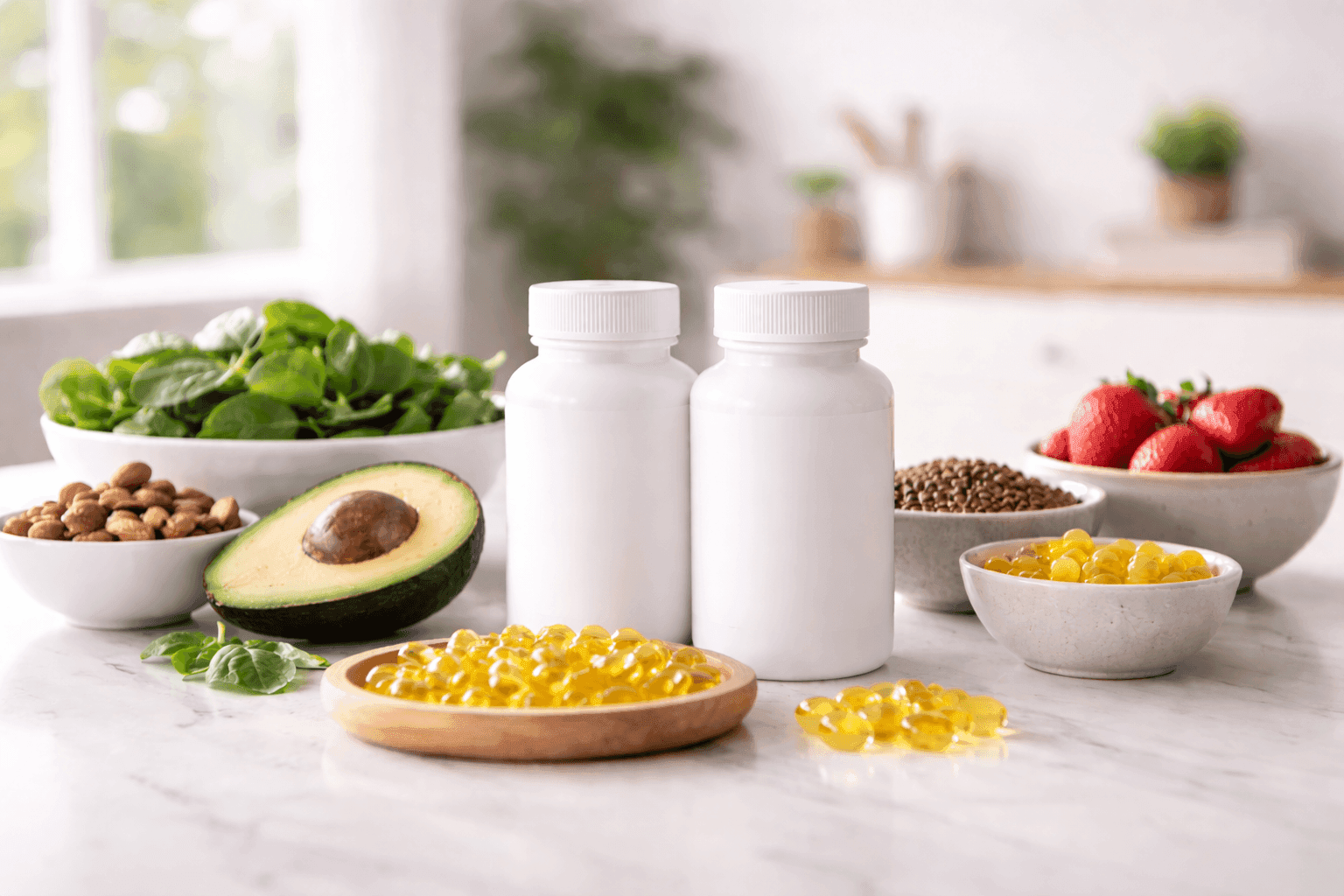
When you start trying to conceive, the prenatal supplement aisle can feel unexpectedly overwhelming. Boxes promise “clinically proven folic acid,” “natural folate,” or “active methylfolate,” each implying that the right choice could protect your fertility and the wrong one could quietly undermine it. Online advice often amplifies this pressure, especially when genetic terms like MTHFR are framed as critical flaws rather than variations.
This confusion tends to land at a time when many women are already tracking cycles closely, paying attention to ovulation windows, and thinking more carefully about their bodies than ever before. It is easy to feel that choosing the wrong form of vitamin B9 might affect egg quality or early pregnancy, even when everything else feels under control.
Quick answer: Folate and folic acid are both forms of vitamin B9, and the most important factor when trying to conceive is having enough usable B9 in your body early and consistently. For most women, standard folic acid works well and remains the most evidence-backed option. Other forms, such as methylfolate, can be appropriate in specific situations, but they are not universally superior.

Lifestyle matters for fertility. A BMC Public Health study found that women with 4–5 healthy habits had a 59% lower risk of infertility.
Fill out the questionnaire, and get a personalised, holistic and evidence-based programme tailored to you.
 takes 3 minutes to complete
Vitamin B9 plays a central role in reproductive biology long before pregnancy is visible on a test. From egg maturation to the earliest stages of embryonic development, rapidly dividing cells rely on adequate folate availability to function correctly.
In women trying to conceive, vitamin B9 supports several key processes:
Because neural tube development begins extremely early, often before a woman realises she is pregnant, clinicians consider vitamin B9 a preconception nutrient, not just a pregnancy supplement. This is why guidance around folic acid is so strongly emphasised even before conception occurs.
The terms folate and folic acid are often used interchangeably, but they are not identical.
Folate refers to the natural forms of vitamin B9 found in foods such as leafy greens, legumes, asparagus, citrus fruits, and avocado.
Folic acid is the synthetic, shelf-stable form used in supplements and fortified foods. It was designed to be consistent, easy to absorb, and reliable across large populations.
Both forms must be converted into the same biologically active B9 compound before the body can use them. For most women, this conversion happens efficiently.
The process involves enzymes that are often grouped under the label MTHFR, a gene that has become disproportionately prominent in online fertility discussions. Some women carry variants that slow conversion slightly, but this does not mean folic acid is unusable or harmful. It simply means that in certain situations, alternative forms can be considered.
The key point remains: the majority of women convert folic acid adequately, which is why it remains the foundation of public health recommendations worldwide.
Folic acid is recommended because it has the strongest and most consistent human evidence for preventing neural tube defects when taken before conception and during early pregnancy.
This content is for educational purposes only. It has been reviewed for scientific accuracy, but it does not constitute medical advice, diagnosis, or treatment. Always consult a qualified healthcare professional regarding medical questions or fertility treatment decisions.
Reviewed for scientific accuracy by: Dr. Mona Bungum
Last reviewed: January 2026
Lifestyle matters for fertility. A BMC Public Health study found that women with 4–5 healthy habits had a 59% lower risk of infertility.
Fill out the questionnaire, and get a personalised, holistic and evidence-based programme tailored to you.
takes 3 minutes to completeNeural tube closure occurs around three to four weeks after conception, often before pregnancy is detected. If folate status is insufficient during this short window, protective effects can be missed regardless of later supplementation.
For this reason, guidelines consistently advise women trying to conceive to take 400 micrograms of folic acid daily, starting before pregnancy and continuing through the first trimester.
Folic acid remains the public health standard because it is:
Even women with good diets may not consistently reach protective folate levels from food alone. Busy schedules, nausea, stress, and natural variability in intake make supplementation an important safety net.
Women who are planning fertility treatment, including those preparing for IVF or other assisted approaches, are also advised to maintain adequate folate intake as part of broader preconception preparation, alongside understanding the IVF process explained in clinical guidance.
Methylfolate, also known as 5-MTHF or L-methylfolate, is the active form of vitamin B9 that the body ultimately uses. Taking it bypasses the conversion step required for folic acid.
Methylfolate may be appropriate for women who:
However, it is important to be precise about the evidence. There is currently no strong clinical proof that methylfolate improves fertility or pregnancy outcomes more than folic acid for the general population of women trying to conceive.
Methylfolate is a targeted option, not a universal upgrade.
Some prenatal supplements avoid the term folic acid and instead use folate or natural folate. This language can be misleading.
In practice, these products may contain methylfolate or a mixture of folate compounds. What matters is not the label but:
Choosing a supplement based on marketing language alone does not improve fertility outcomes. Meeting folate requirements early and reliably does.
For most women trying to conceive:
Higher doses, typically 4–5 mg daily, are recommended only in specific medical situations, including previous neural tube defects, certain medications, diabetes, obesity, or malabsorption conditions. These decisions should be guided by a clinician.
More is not always better. Excess supplementation without indication can disrupt other nutrient balances and does not increase fertility.
Supplementation does not replace diet. Folate-rich foods support overall metabolic and reproductive health and provide additional nutrients relevant to fertility.
Good dietary sources include:
Think of supplementation as insurance for early development, while diet supports baseline fertility health throughout the cycle.
Many women worry that folic acid is “synthetic” and therefore unsafe. In this context, synthetic simply means stable and standardised. At recommended doses, folic acid has decades of safety data.
Others worry about starting too late. If supplementation has not yet begun, starting now is still beneficial. Eggs and follicles mature over time, and future cycles benefit from adequate folate status.
Some women who experience difficulty conceiving worry that supplementation has “failed.” Fertility outcomes are complex, and uncertainty is common, particularly in cases of unexplained infertility. Folate supports early development, but it does not override all biological factors.
Vitamin B9 works within a broader physiological context. Chronic stress, inflammation, and metabolic strain can all influence reproductive outcomes.
Research exploring how stress affects fertility highlights that nutritional adequacy supports resilience but cannot fully counteract ongoing physiological stress. This is another reason why supplementation should be seen as supportive, not curative.
At Conceivio, we help women make sense of fertility information without unnecessary fear or complexity. Supplement decisions are explained within evidence-based frameworks, not trends.
We support women by:
For women beginning the journey of how to become a parent with fertility treatment, foundational steps like appropriate folate intake are part of broader preparation, not isolated fixes.
Both folate and folic acid provide vitamin B9, which is essential before pregnancy. For most women, folic acid works well and has the strongest evidence for protecting early development. The most important factor is taking enough vitamin B9 consistently before conception.
Most guidelines recommend 400 micrograms of folic acid daily for women trying to conceive. It should be started at least one month before pregnancy, ideally earlier, and continued through the first trimester unless a clinician advises otherwise.
Folic acid should ideally be started before conception, because neural tube development occurs very early, often before pregnancy is confirmed. Starting supplementation as soon as you begin trying to conceive helps ensure protective levels are already in place.
Yes. Folic acid has been used safely for decades at recommended doses and is supported by extensive research. At standard preconception doses, it is considered safe and effective for women planning pregnancy.
Not necessarily. Many women with MTHFR variants still convert folic acid adequately. Methylfolate can be considered in specific clinical situations, but it is not automatically required for all women with MTHFR.
Vitamin B9 supports DNA synthesis and cell division, which are important for egg maturation. While it does not guarantee improved egg quality, adequate folate status helps create a healthier environment for egg development.
A healthy diet rich in folate is beneficial, but food intake alone may not reliably reach protective levels every day. Supplementation helps ensure consistent vitamin B9 availability during the critical early window of conception.
It is not too late to start. Beginning folic acid now can still support future cycles and early pregnancy. Consistency going forward matters more than missed time in the past.
There is no strong evidence that methylfolate improves fertility outcomes more than folic acid for most women. It may be useful in specific medical contexts, but it is not proven to be superior for the general population trying to conceive.
Higher doses are not always better and should only be taken if recommended by a clinician. Excessive supplementation without indication may interfere with other nutrient balances and does not increase fertility.
The outcome that matters most is simple: having enough usable vitamin B9 on board before conception begins. That is what protects early development and supports female fertility, regardless of which label appears on the bottle.