

The Menstrual Cycle
Welcome to the empowering journey of your menstrual cycle. Here, we embrace its profound strength, which is unlocked through a deeper understanding of this natural process.
The menstrual cycle is an intricate biological function governed by sex hormones and influenced by others in the body. It is divided into four key phases: the menstrual phase, follicular phase, ovulation phase, and luteal phase. Two essential processes happen simultaneously during this cycle: the ovarian cycle and the endometrial cycle.

Essential Hormones in the Menstrual Cycle
Follicle Stimulating Hormone (FSH)
- Produced by the pituitary gland
- Oversees egg development in the ovaries
- Stimulates the growth of follicles in the follicular phase
Oestrogen
- Secreted by the ovaries
- Promotes the growth of the uterine lining during the follicular phase
- Plays a vital role in bone density, muscle development, cardiovascular health, brain function, and skin wellness
Luteinizing Hormone (LH)
- Released by the pituitary gland
- Induces ovulation in the ovulation phase
- Supports the function of the corpus luteum
Progesterone
- Produced by the ovaries (specifically the corpus luteum)
- Prepares and sustains the uterine lining for potential pregnancy
- Aids in mood regulation, relaxation, pregnancy, thyroid function, and blood sugar control
Testosterone
- Secreted by the ovaries and adrenal glands
- Assists with ovulation
- Impacts muscle mass, bone health, cognitive performance, motivation, and libido in both men and women
- When these hormones are in balance, the menstrual cycle remains healthy and consistent, fostering overall well-being.
Other Hormones Influencing the Menstrual Cycle
Insulin
- Produced by the pancreas
- Manages blood sugar levels
- Supports energy metabolism
- Impacts the regulation of sex hormones
Cortisol
- Secreted by the adrenal glands
- Regulates stress responses, metabolism, immune functions, and blood pressure
- Stress management is crucial, as high cortisol can disrupt the menstrual cycle
- In stressful situations, the body prioritizes survival over reproduction
By maintaining balanced blood sugar and managing stress through mindful practices, these hormones can be optimized, promoting healthier menstrual cycles.
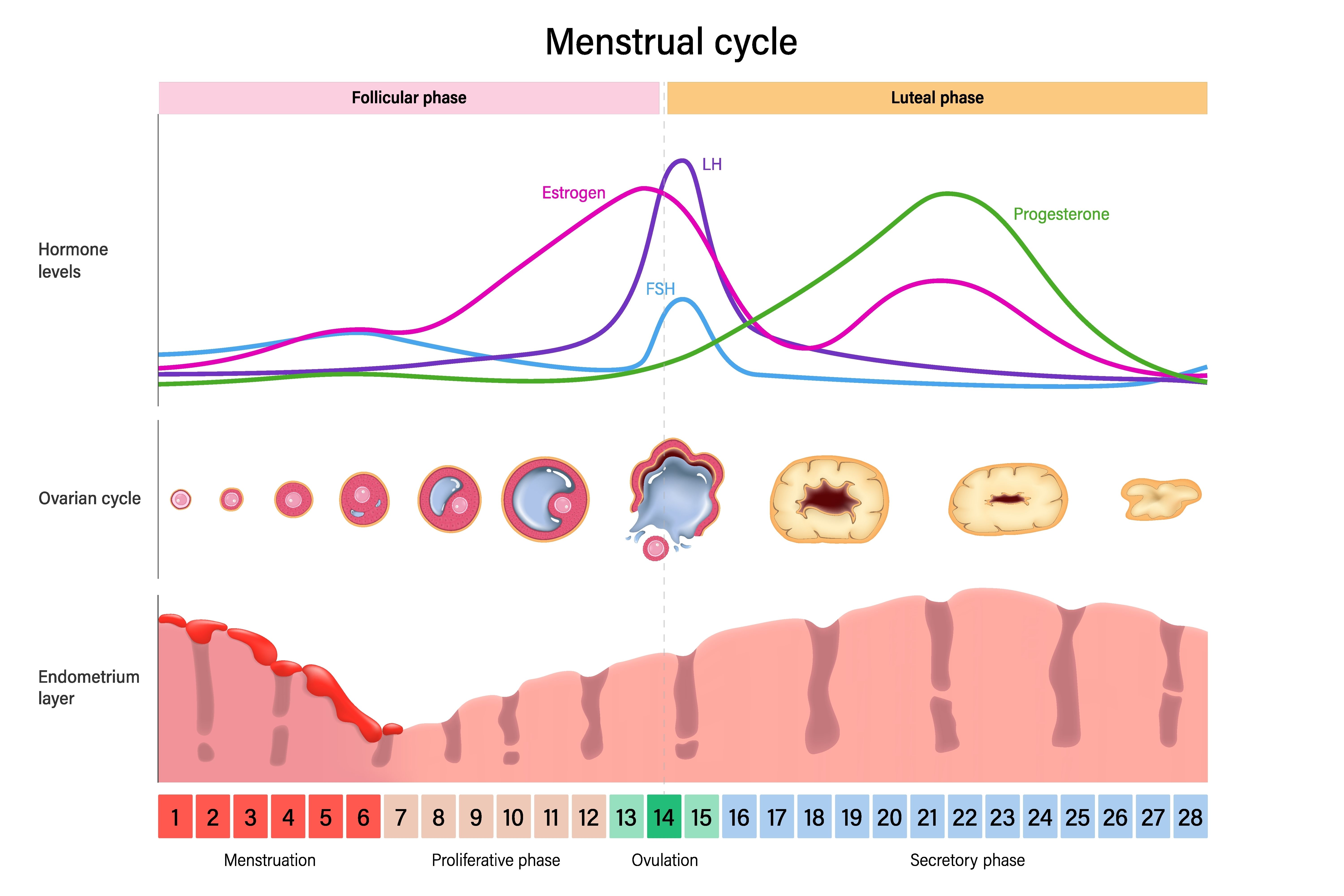
The Four Phases of the Menstrual Cycle
Menstrual Phase (3-7 Days)
- The body sheds the uterine lining due to the absence of pregnancy
- Hormonal levels are low
- FSH levels start rising at the end of the phase, stopping the bleeding
Follicular Phase (7-10 Days)
- FSH stimulates follicle maturation in the ovaries
- One follicle releases oestrogen, promoting the growth of the uterine lining
Ovulation Phase (3-5 Days)
- Oestrogen reaches its peak, prompting a surge in LH
- LH triggers the release of an egg from the follicle
- Testosterone rises to facilitate ovulation
- This is the fertile window in the cycle
Luteal Phase (9-18 Days)
- The follicle transforms into the corpus luteum, producing progesterone
- The uterine lining thickens in preparation for potential pregnancy
- If fertilization occurs, the luteal phase continues; otherwise, progesterone declines, initiating the next menstrual cycle

The Ovarian and Endometrium Cycles
The menstrual cycle consists of two simultaneous processes:
Ovarian Cycle
Includes follicle development, ovulation, and corpus luteum formation.
Endometrial Cycle
Involves the growth and maintenance of the uterine lining.
Each individual’s cycle is unique. Tracking your cycle can provide insights into your personal rhythm and patterns.
Seasons and the Menstrual Cycle
The menstrual cycle can be likened to the four seasons, symbolizing the various energy shifts that occur:
Menstrual Phase → Winter
- Hormone levels are at their lowest
- A time to rest and regain energy
- Reflective and introspective mood
Follicular Phase → Spring
- Hormones begin to rise, boosting energy levels
- A more social and creative time
- A feeling of renewal and productivity
Ovulation Phase → Summer
- Hormones peak, bringing high energy
- Confidence, sensuality, and outgoingness dominate
- The most fertile and sociable part of the cycle
Luteal Phase → Autumn
- Hormones start to decline, preparing the body for rest
- Energy decreases, signaling a need for a slower pace
- Heightened emotional sensitivity and introspection
- Understanding this seasonal connection can help you align your lifestyle with your natural rhythm.
Acknowledgements:
Thanks to the following experts for contributing to this knowledge:
- Alisa Vitti, In the Flo
- Dr. Anthea Todd, Female Fundamentals
- Dr. Jorge E. Chavarro, Dr. Walter C. Willett, and Patrick Skerrett, The Fertility Diet
- Nadine Muller, Womb Power & Cycles (Bloom)