
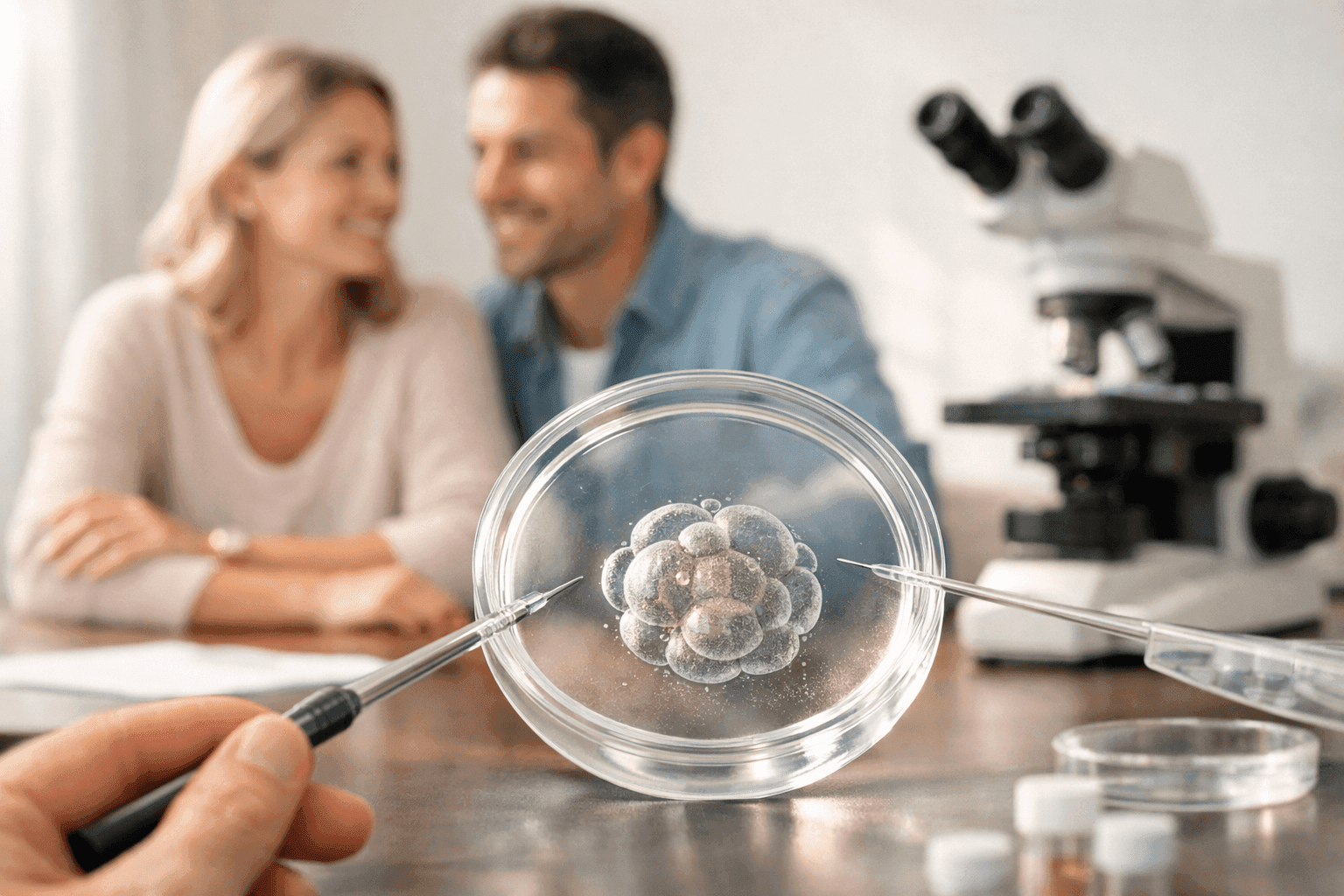
Hearing that embryos have stopped developing can feel devastating, especially after the physical and emotional investment of fertility treatment. For many people, this moment raises fear, grief, and a deep sense of uncertainty about whether parenthood is still possible.
Patients often blame themselves when embryo development fails. They wonder if their body has let them down, whether something was missed, or if the same outcome will repeat in future cycles. The lack of clear explanations can make this experience even harder to process.

Lifestyle matters for fertility. A BMC Public Health study found that women with 4–5 healthy habits had a 59% lower risk of infertility.
Fill out the questionnaire, and get a personalised, holistic and evidence-based programme tailored to you.
 takes 3 minutes to complete
Quick answer: Embryo development failure is common in fertility treatment and usually happens because of chromosomal, egg, sperm, or energy-related factors that are largely beyond a patient’s control. It is rarely caused by something you did or did not do, and it does not mean future cycles cannot succeed.
Fertilisation is often imagined as a single moment when sperm meets egg. In reality, it is a complex, multi-step biological process that must unfold in the correct sequence for an embryo to develop normally.
For fertilisation and early development to succeed:
Failure at any one of these stages can lead to fertilisation failure or embryo development failure shortly afterwards. Importantly, this can happen even when sperm counts, egg numbers, and hormone levels appear normal.
Standard semen analysis looks at sperm count, movement, and shape. While useful, these measures do not capture everything that matters for embryo development.
Sperm can appear healthy under a microscope while carrying damaged DNA. This damage, often referred to as sperm DNA fragmentation, can interfere with normal embryo development after fertilisation has occurred.
Higher levels of DNA fragmentation have been linked to:
DNA damage can be influenced by age, smoking, alcohol use, chronic stress, fever, , and underlying medical conditions, all of which interact in ways that current testing cannot fully capture.
This content is for educational purposes only. It has been reviewed for scientific accuracy, but it does not constitute medical advice, diagnosis, or treatment. Always consult a qualified healthcare professional regarding medical questions or fertility treatment decisions.
Reviewed for scientific accuracy by: Dr. Mona Bungum
Last reviewed: January 2026
Lifestyle matters for fertility. A BMC Public Health study found that women with 4–5 healthy habits had a 59% lower risk of infertility.
Fill out the questionnaire, and get a personalised, holistic and evidence-based programme tailored to you.
takes 3 minutes to completeSome sperm are able to enter the egg but fail to trigger the biochemical signals needed for the egg to activate and divide. This can result in fertilisation that appears normal initially but does not progress.
In IVF, intracytoplasmic sperm injection is often used to bypass issues with sperm movement or egg penetration. However, ICSI cannot correct genetic or DNA-level problems inside the sperm, which is why embryo development failure can still occur even with advanced laboratory techniques.
Egg quality is one of the most important determinants of embryo development. While sperm contributes half of the genetic material, the egg provides nearly everything else required for early growth.
The egg supplies:
If these systems are compromised, embryos may fertilise but fail to develop beyond the early stages.
Age
Egg quality declines with age due to changes in chromosome alignment and energy production. This is a biological process, not a reflection of health, effort, or lifestyle choices.
Metabolic And Hormonal Health
Conditions such as insulin resistance, thyroid dysfunction, or chronic inflammation can affect egg maturation, since each can disrupt the hormonal balance needed for healthy egg development.
Oxidative Stress
Oxidative stress can damage cellular structures within the egg, including mitochondria. Poor sleep, illness, and environmental exposures can all contribute, although many factors remain outside conscious control.
It is important to note that younger patients can experience egg-related issues, and many older patients still produce viable eggs. Egg quality is probabilistic, not absolute.
One of the most common causes of embryo development failure is chromosomal abnormality.
Human embryos require the correct number of chromosomes to continue developing. When there are too many or too few, a condition known as aneuploidy, development often stops naturally.
Key points patients should understand:
Many embryos with chromosomal abnormalities fertilise and divide for several days before arresting. This can be particularly distressing, as early progress often raises hope before development stops.
Genetic testing of embryos can sometimes provide clarity, but it cannot prevent these errors from occurring in the first place.
Early embryos have very high energy demands. This energy is generated by mitochondria, which are inherited entirely from the egg.
When mitochondrial function is impaired:
Mitochondrial efficiency declines with age and can be affected by oxidative stress and metabolic health. At present, medicine has limited ability to directly correct mitochondrial dysfunction, although research in this area is ongoing.
Embryo arrest typically occurs between days two and five of development. This stage requires the embryo to transition from using maternal instructions to activating its own genome.
Failure during this transition can result from:
In many cases, no single cause can be identified, even after extensive testing. This uncertainty can be frustrating, but it reflects the limits of current scientific understanding rather than a failure of care.
Modern IVF laboratories are highly controlled environments designed to support embryo development. Temperature, oxygen levels, culture media, and handling protocols are carefully optimised.
Even so, embryos are biologically variable. While laboratory conditions can influence outcomes, most cases of embryo development failure are driven by intrinsic embryo factors rather than external handling.
It is important to separate embryo development from implantation.
Uterine factors tend to influence whether a developed embryo implants and progresses into pregnancy, while each stage of the IVF process, stimulation, retrieval, fertilisation, and transfer can be evaluated separately to identify where development paused.
One of the most difficult truths for patients is that chance plays a significant role in reproduction.
Even among:
Not all embryos will develop. Human reproduction is inherently inefficient, and natural selection occurs at the embryo level long before pregnancy begins.
This is not a failure of your body. It is a feature of human biology.
Fertility medicine offers increasingly sophisticated tools, including:
These tools can provide valuable insights, but they do not explain every outcome. Some cases of embryo development failure occur for reasons that cannot yet be measured or predicted.
Experiencing embryo development failure does not mean:
Many patients go on to have successful pregnancies after earlier failures, sometimes with adjusted protocols and sometimes without a clear explanation for the change.
Helpful next steps include:
Outcomes can improve even when no single cause is identified, a pattern often seen in cases of unexplained infertility.
Yes. Embryo development failure is common in IVF and natural conception alike. Many embryos stop developing due to chromosomal or cellular issues that occur by chance, even in young and healthy individuals. This reflects the natural inefficiency of human reproduction rather than a problem with care or effort.
Embryos may stop developing when chromosomal abnormalities, energy shortages, or genetic activation errors occur. These issues often arise during the earliest stages of cell division and are usually beyond anyone’s control. In many cases, there is no single identifiable cause.
No. Embryo arrest in one cycle does not predict failure in future cycles. Many people go on to have successful pregnancies after earlier embryo development failure, sometimes with changes in treatment and sometimes without any clear explanation for the improvement.
Yes. Standard semen tests assess count, movement, and shape, but they do not always detect DNA damage. Sperm with fragmented DNA can fertilise an egg but still contribute to embryos stopping development a few days later.
Egg quality plays a central role in early embryo development. The egg provides energy and instructions needed for early cell division, so problems with egg structure or energy production can lead to embryo arrest even when fertilisation initially occurs.
The likelihood of embryo development failure increases with age, mainly due to a higher rate of chromosomal abnormalities in eggs. However, these issues can occur at any age, and age alone does not determine whether embryos will develop successfully.
Lifestyle factors can influence overall reproductive health, but most cases of embryo development failure are not caused by specific behaviours. Patients should avoid self-blame, as many failures occur despite healthy habits and careful medical care.
Usually not. Fertilisation and early embryo development happen before the uterus is involved. Uterine factors typically affect implantation rather than whether an embryo develops in the first few days.
Genetic testing can help identify chromosomally normal embryos, but it cannot prevent embryos from developing abnormalities. It offers information, not guarantees, and does not explain every case of embryo arrest.
Sometimes adjustments are recommended, such as reviewing stimulation protocols or testing sperm DNA. In other cases, no clear change is needed. Decisions are best made by reviewing results carefully with a fertility specialist and considering both medical and emotional factors.
Embryo development failure sits at the intersection of genetics, cell biology, and chance. It is common, often unavoidable, and rarely caused by patient behaviour.
Understanding the science can help replace self-blame with perspective. At Conceivio, we believe people deserve explanations that are honest, compassionate, and grounded in evidence.
At Conceivio, we provide inclusive fertility care grounded in science and compassion. Our resources are designed to help you make informed, calm decisions at every stage of your fertility journey.